At a glance
What this page covers
- For
- Engineers evaluating whether a magnetic surrogate could support early design exploration without hiding unfamiliar inputs.
- You will leave with
- A practical sequence for baseline comparison, held-out families, residual review, unfamiliar-input checks, and escalation.
- Evidence status
- Research specification and evaluation contract; no model performance result is claimed.
- Boundary
- No trained model, benchmark, public dataset, project-specific threshold, or hardware validation is presented.
Starting point, decision and reusable output
- Decision
- Choose use, warn, request higher fidelity, or abstain according to the available evidence.
- Starting point
- Magnetics domain knowledge helps; no machine-learning programming is required to apply the acceptance checklist.
- Reusable output
- A six-item acceptance checklist and a four-route refusal policy.
Read the surrogate acceptance note, then practise the grouped-split mechanic on synthetic converter data in the runnable starter lab.
A surrogate is a faster approximation trained to reproduce the output of a slower reference method inside a stated scope. Magnetic calculations and higher-fidelity simulation can become the slowest part of broad design exploration. A surrogate model could return an estimate faster, but speed creates value only after the engineer defines where that estimate has earned permission to be used. Outside the evaluated region, a precise-looking number can be less useful than no number at all. This project currently defines the evaluation contract; it does not present a trained surrogate or measured speedup.
Why magnetic exploration needs speed and physical context
Core geometry, material behaviour, winding arrangement, excitation, temperature, and frequency interact. Evaluating many combinations with the strongest available method may be too slow for early exploration, yet simplifying those interactions too aggressively can hide the very effects that determine feasibility.
The risk of confusing fast estimates with broad coverage
A low average error does not show whether the largest errors occur near saturation, in one component family, or outside the operating region represented by the evidence. The model may interpolate well between familiar examples while failing on a new geometry or excitation pattern.
The dangerous output is not always an obvious numerical failure. It is a plausible estimate that enters the design process without a visible warning that the input is unfamiliar.
Treat the surrogate as a routed approximation
The system should convert evidence quality into one of four actions:
- use the estimate for the stated exploratory purpose;
- warn that evidence is weaker or the point is near a boundary;
- request higher fidelity through calculation, simulation, or measurement;
- abstain when the input or output falls outside the accepted contract.
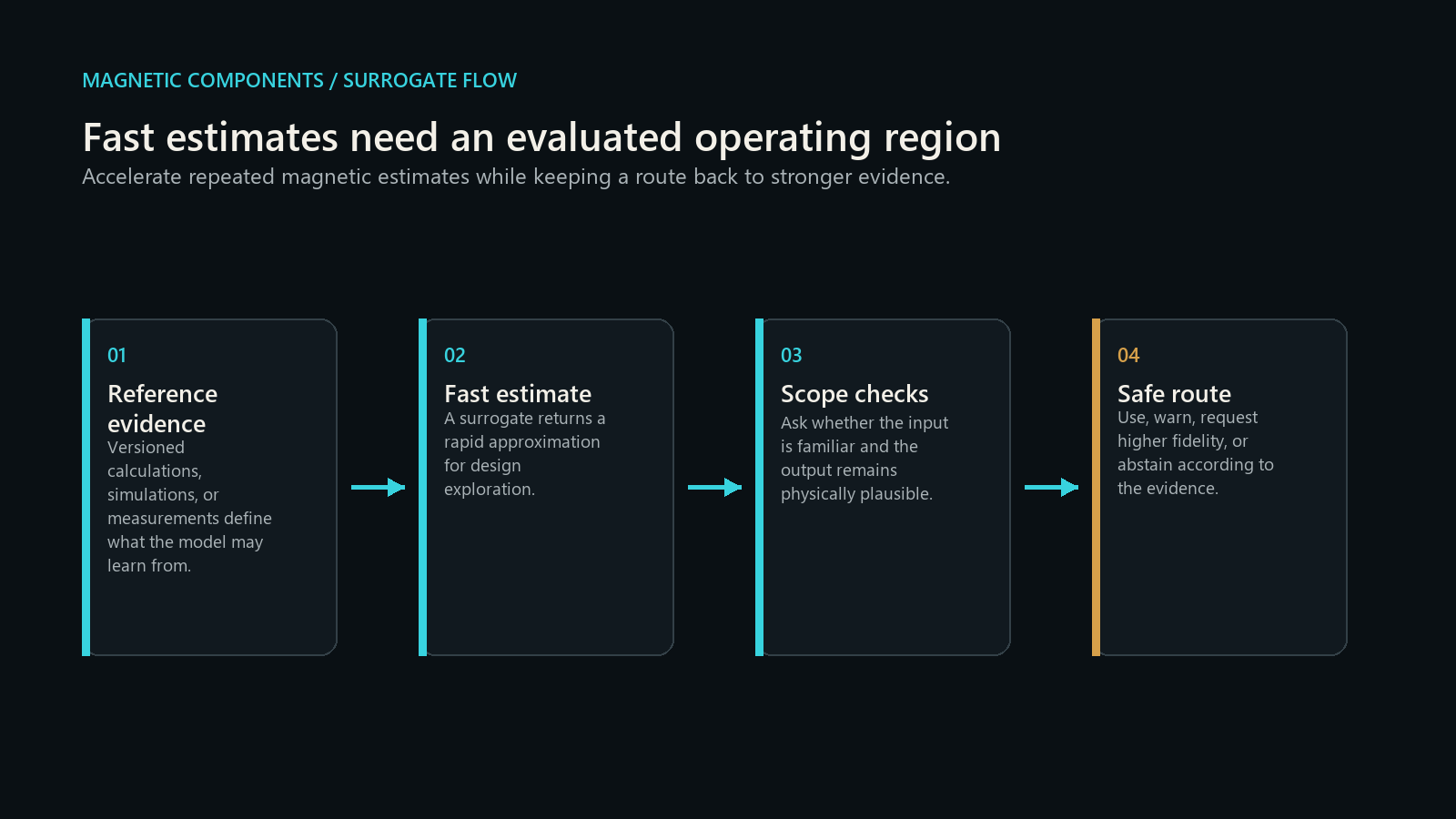
Connect the fast estimate to an evidence boundary
1. Define the reference evidence
Versioned calculations, simulations, or measurements establish what the surrogate may learn from. Inputs, outputs, units, material assumptions, solver settings, and provenance need to remain tied to each record.
2. Compare with a useful baseline
The first question is not whether a complex model can fit the data. It is whether the surrogate improves on the practical approximation already available for the intended decision.
3. Evaluate complete unseen families
Rows from the same component design are related. Holding back complete component families gives a more honest view of whether the model performs on families not represented during fitting, within the stated data and method scope.
4. Map where errors concentrate
Residuals should be inspected against meaningful physical inputs, operating regimes, families, and target magnitude. A model that is acceptable on average may still need a warning or refusal region.
5. Route weak evidence to a stronger method
Unfamiliar-input checks, uncertainty, and physical constraints matter only when they change the action. The workflow must specify what happens next and who reviews the result.
What must exist before a trust claim
| Evidence item | Engineering question |
|---|---|
| Versioned data with provenance | Which geometries, materials, conditions, and methods support the model? |
| Practical baseline comparison | Does the surrogate add enough value to justify its complexity? |
| Held-out component families | Does performance survive on component families excluded from fitting? |
| Residual and worst-case views | Where does the approximation become unreliable? |
| Unfamiliar-input and physical checks | Does the workflow recognise weak or implausible evidence? |
| Independent higher-fidelity review | Is the estimate suitable for the stated decision inside the stated scope? |
In this checklist, a baseline is the useful calculation or approximation that the surrogate must improve. A residual is prediction minus reference; residuals inspected across inputs, regimes, target magnitude, and component families can reveal where errors concentrate. A held-out family is a complete component family excluded from fitting so related rows cannot leak into evaluation.
A conceptual unfamiliar-family case
Suppose a model is fitted on two documented core families and receives an input from a third family. The simple baseline still returns a plausible estimate, but the unfamiliar-input check reports that the geometry and material combination lies outside the evaluated population. Without benchmark results, the correct route is not to claim that either estimate is accurate. The workflow should request the reference calculation or abstain, record the new family, and use the result only after an authorised evaluation updates the evidence boundary.
Define the refusal rule before selecting the model
Write the four possible outputs, use, warn, request higher fidelity, and abstain, before training. For each one, define the required evidence, the intended engineering use, and the person responsible for the next decision.
Then test the simplest baseline first. A surrogate is valuable only if it reduces repeated work while keeping the limits and escalation path visible, not merely because it produces a faster number. Continue with the surrogate acceptance note or practise the grouped-split mechanic on synthetic converter data in Start Here; neither route requires an email address.