At a glance
What this page covers
- For
- Power-electronics engineers exploring how simulated fault evidence could be organised before any hardware study is authorised.
- You will leave with
- A simulation-only triage flow that preserves context, competing explanations, abstention, and engineering review.
- Evidence status
- Research specification supported by a conceptual workflow; no public benchmark, trained diagnostic model, or hardware dataset.
- Boundary
- No hardware measurements, bench validation, safe-measurement guidance, or transfer from simulated cases to physical converters.
Starting point, decision and reusable output
- Decision
- Decide which additional simulation check can separate competing explanations, or whether the simulated evidence is too weak to continue.
- Starting point
- Flyback operating knowledge is useful; no machine-learning code is required to inspect the decision contract.
- Reusable output
- A four-stage workflow, six-part evaluation plan, and five-question review checklist.
Use the grouped-baseline lab to learn why complete converter designs must stay together during evaluation.
This project is limited to simulated flyback cases. A simulated case can still contain incomplete operating context, ambiguous waveforms, and several plausible explanations. If software compresses that uncertainty into one confident label, it can create a misleading dataset or send the next simulation run in the wrong direction. The research question is narrower: can a workflow preserve what is known, keep competing simulated explanations visible, request the most discriminating next simulation check, and abstain when the evidence is insufficient?
When one simulated symptom supports several explanations
Within simulation, low output voltage, unexpected current limiting, unstable switching, or excessive stress can arise from operating point, parameter choices, control interaction, model assumptions, numerical settings, or extraction logic.
The same simulated waveform can also mean different things when the model, load, input voltage, parameter sweep, initial state, or extraction window changes. A triage result is therefore only as strong as the simulation contract attached to the evidence.
Why a plausible answer can still send the investigation off course
When a tool hides missing context, it can make three damaging mistakes:
- treat an observation as proof of one cause;
- recommend another run that does not separate the leading explanations;
- continue even when the available evidence is too weak for a supported simulation route.
The cost is not only a wrong label. It is another simulation cycle, a contaminated evaluation set, or false confidence in a rule that has never been checked against hardware.
Aim for the next discriminating simulation check
The workflow is not designed to produce a diagnosis at any cost. Its useful output is a compact review record that answers four questions:
- What operating evidence is available, and under which conditions?
- Which explanations remain plausible inside the stated simulation model?
- Which additional simulation condition or model check would separate those explanations most effectively?
- Is the evidence sufficient to continue, or should the workflow stop and escalate?
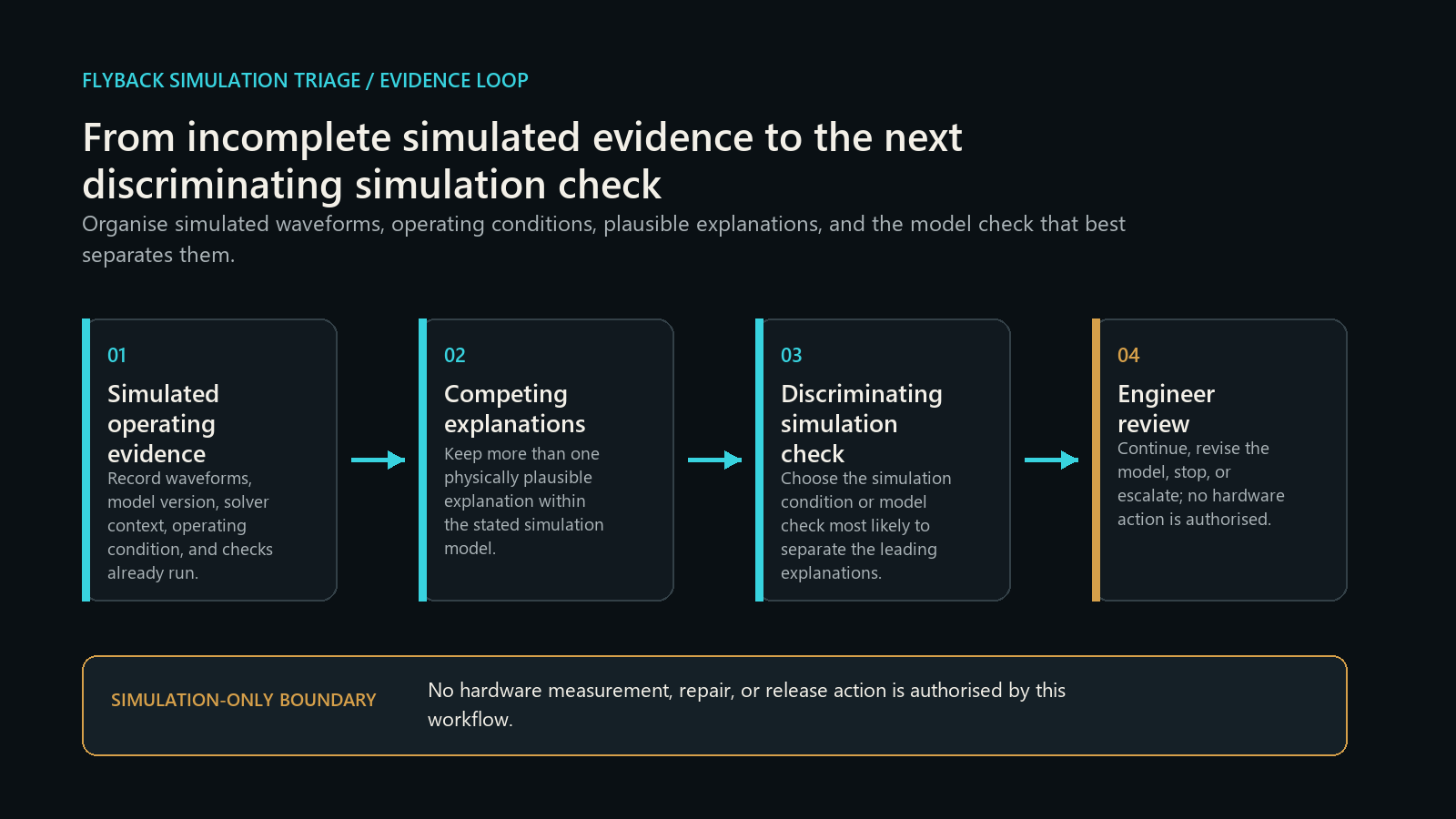
A four-stage workflow that preserves uncertainty
1. Establish the simulated operating evidence
Record the simulated converter state before interpreting it: circuit/model version, operating condition, virtual observation point, solver context, extracted behaviour, and checks already performed. Missing context stays visible instead of being silently guessed.
2. Keep competing explanations alive
The workflow maintains several causes that remain physically plausible within the stated simulation model while evidence is incomplete. Agreement is not forced merely because one explanation sounds more familiar.
3. Choose a simulation check that can change the decision
A useful next check should distinguish between the leading simulated explanations. The engineer reviews whether it is well specified, reproducible, and likely to add decision-relevant information. Moving to hardware would require a separate authorised protocol and evidence gate that this project does not provide.
4. Update, abstain, or escalate
New evidence can strengthen one explanation, weaken another, expose a new possibility, or show that the case is outside the evaluated scope. Abstention is a valid result when the evidence is insufficient.
How the workflow will be evaluated
The evaluation plan connects the workflow to six evidence checks:
| Evidence item | Why it matters |
|---|---|
| Versioned simulated cases and provenance | Shows which circuit/model versions, conditions, observations, and labels were evaluated |
| A simple engineering baseline | Tests whether added model complexity improves the actual task |
| Complete designs held out for evaluation | Prevents near-duplicate simulated records or operating points from overstating generalisation |
| Missing-context and unfamiliar-case tests | Checks whether the workflow warns or abstains when simulated evidence weakens |
| False-route review | Evaluates the consequence of a wrong simulation route, not only label accuracy |
| Engineering review of the evidence contract | Confirms that the simulated evidence and proposed next check remain technically coherent |
A baseline is the simplest serious way to perform the same triage task, such as an explicit engineering rule. Grouped evaluation means keeping every operating point from one simulated converter design on the same side of the train/test boundary. Abstention means the workflow refuses to choose a route when the available simulated evidence does not support one. These terms describe evaluation discipline, not hardware capability.
A five-question review before accepting AI assistance
For this simulation-only triage workflow, ask:
- Can I trace every conclusion back to simulated observations, model version, and operating conditions?
- Does it preserve competing causes when evidence is incomplete?
- Does the proposed simulation check actually separate those causes?
- Can it warn, abstain, and request stronger evidence?
- Does an engineer review the simulated evidence and own the next research action?
If any answer is no, the workflow may still organise simulated records, but it should not choose the next route. The next project milestone is a grouped unseen-design comparison against a simple engineering baseline, with explicit unfamiliar-case and abstention tests. Hardware confirmation is a separate future phase and is not authorised by this page.